
The Robert Morris Inn 1710
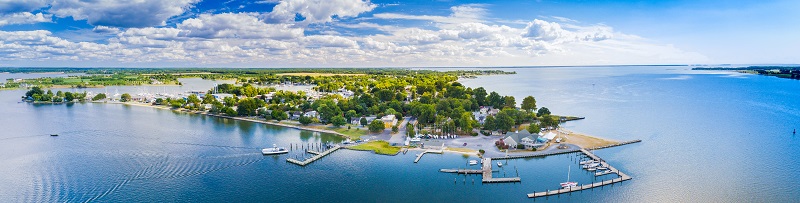
The waterbound village of Oxford was once Maryland's largest port of call and is still an important center for boat building and yachting. Oxford is a protected harbor for watermen who harvest oysters, crabs, clams and fish.
Chartered back to Augustine Herman's 1673 map of Maryland & Virginia, Oxford is one of Maryland's oldest towns. Mandated in 1694 by Maryland legislation as the first and only port-of-entry on the Eastern Shore, the town gained significant prominence in colonial days and remained a booming port for over 75 years.
Once named Williamstadt under the reign of Dutch King William III of England. Merchants from London, Liverpool and Bristol established stores in Oxford to trade merchandise for tobacco. Second only to Annapolis, Oxford was recognized as port to the largest number of ships. Ships delivering goods to the port could number as high as seven at any given time. When going on board, one would find that the favored cargo included tobacco, hides, salt port, wheat and lumber.
The Most prominent merchant was Robert Morris, the father of the financier of the American Revolution. Arriving in Oxford in 1738, Morris acquired a fortune as chief factor for the Foster Cunliffe & Sons, a large Liverpool trading house. A part of Morris' residence is incorporated in the Robert Morris Inn. Oxford's trade was unfavorably affected by the War of Independence and the popularity and growth of Baltimore a a chief transshipment point for the Chesapeake Region.
The economy began to wane in the 1700s but came alive again in the mid-1800s. The construction of two churches, the Oxford Military Academy opened, the railroad terminus for the Maryland Delaware Railroad was built., two banks were erected and the first brick sidewalks were laid. Boat building skyrocketed in the late 1800's and two steamboat wharves serviced the rail and boat services.
During the early 1900s, Oxford slowed down again. As Oxford and the nation were affected by World War II, the only successful business left was boat building. Many of the residents left to seek employment in wartime industries.
While the economy was hard hit at times, Oxford maintained
its charm and community unity. Today, the town is compared to
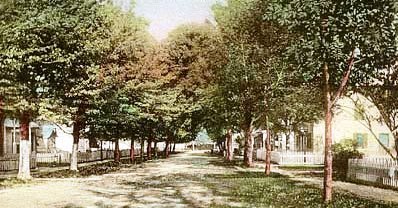
a picture-perfect postcard. Its beauty is recognized by
visitors, magazines and books and protected and preserved by its
residents. Elegant historic homes frame the banks of the Tred
Avon River while sailboats and yachts gently pass by well manicured
landscapes. With approximately 700 residents, the town's
charming and unique characteristics portray miniature American at
its very best.
Some time after the death of Robert Morris Senior the house was eventually converted for use as a hotel or inn and is referred to in sources as River View House and Riverview Hotel. The prominent Goldsborough family occupied the house for a long time dur ing the first half of the 19th century. In April of 1831 records ind icate the property passed to Charles Willis; Willis in turn sold the property to William H. Groome on November 23, 1839. Mr. Groome owned the Inn for twenty four years, along with Elizabeth Kennard. They in turn sold it to Samuel Pentz in March of 1863. Consequently, the Inn passed through the hands of William Pentz, and R.H. Chamberlain to Albert K. Robins. Mr Robins changed the name to the Robins Hotel, added much of the inter ior fabr ic and the entire exter ior frame, which remains intact today. This major alteration which removed a substantial portion of the or iginal structure and encased the remaining section in a Second Empire influenced cloak was made about the mid to late 1870s.
The Inn has been enlarged several times since its first
use as a private home. The staircase which leads to the guest rooms
is the enclosed type of the Elizabethan period and was built prior
to 1710. The flooring in the upstairs hall is Georgia white pine.
The nails were hand made, and the 14 inch square beams and
pilasters were fastened with hand hewn oak pegs. Four of the guest
rooms (rooms 1, 2, 15 & 17) have hand made wall paneling from
earlier periods and fireplaces built of brick made in England
and used as ballast in the empty sailing ships arriving to
trade.
The impressive murals in the dining room were made from wallpaper
samples used by manufacturers salesmen, 140 years ago. "The Four
Seasons" - the Plains of West Point, Winnepeg Indian Village,
Natural Bridge of Virginia and Boston Harbour - were all printed on
a screw-type press using 1600 woodcut blocks carved from ornagewood
and hand painted. In 1962, during the redecoration of the White
House, Mrs John F Kennedy found the original wallpaper of this
design in an historic home in western Maryland, had the paper
removed and placed on the walls of the White House reception
room.
The Tavern's slate floor came from Vermont and over
the fireplace is the Morris Coat of Arms, a magnificent oak, deep
relief carved by John White. The Raleigh Tavern in colonial
Williamsburg inspired the chimney which arises from the massive
fireplace in the Taproom. Complimenting the fine woodwork of this
room is a hand-carved log canoe under sail by Ted Hanks of
Oxord.
Entering the Inn from the main street is like stepping back 300
years, a pristine yet historic interior welcomes with timber beams,
panelled walls and open fires in the cooler months. Move on through
to Salter's Tavern named after our celebrity chef owner, Mark
Salter and you enter a more modern addition featuring historic red
brick walls and old slate floors, again featuring
magnificent fires in the cooler months and offering casual outside
dining on our Terraces and Verhanda during balmy warm
summers.
The first floor houses the formal Dining Room, Tavern
and the Tap Room, in all seating up to 170 customers, while
the 14 historic bedrooms are located on the second and third
floors. Adjacent to the Inn we have Bottle Cottage, housing two
delightfull modern waterfront rooms.